


 My Basket
0
My Basket
0

New School Year, New Start: 6 Golden Habits to Build Strong Chinese Learning
Jan 28, 2026
Prepare for PSLE 2026 from the First Day of School | Exclusive Sharing by Le Xue Education
Brief Overview:
[ New school year, new start! For Primary 6 students preparing for PSLE 2026, building strong Chinese learning habits early is key. In this article, Le Xue Education shares 6 golden habits including daily 15-minute morning reading, the exclusive 3R character learning method, creating a personal writing content bank, twice-weekly oral practice, using a mistakes notebook, and joining professional tuition classes. Learn practical tips, student success stories, and step-by-step guidance to improve reading, writing, oral, and comprehension skills. Start today and help your child confidently achieve top PSLE Chinese results! ]
The new school year has started. For Primary 6 students preparing for PSLE 2026, this is a very important year.
With 24 years of teaching experience in Singapore, Le Xue Education has helped many students improve from failing Chinese to achieving AL1 or AL2. In this article, Vivien Le, former senior Chinese teacher from Catholic High School, shares 6 golden habits to help your child build strong Chinese learning habits and start the new school year with confidence.
Method 1: 15-Minute Daily “Morning Reading” – The Golden Time to Build Language Sense
Why is morning reading so important?
Based on our 24 years of teaching experience, mornings are when children’s memory and focus are at their peak. Just 15 minutes of Chinese reading every morning can: • Improve language sense and reading fluency • Increase familiarity with Chinese sentence structures • Build a rich pool of writing material • Enhance oral expression for speaking tests
How to start the morning reading routine
Step 1: Choose the Right Reading Materials
• Recommended for upper primary students: Youth Literature《少年文艺》, Yi Lin (Junior Edition) 《意林少年版》, and past-year PSLE comprehension passages
• Select 1–2 short articles each week (about 300–500 words)
• Content should be close to daily life and carry positive learning values
Step 2: Read Aloud the Right Way
• Do not read silently. Reading aloud helps train oral and PSLE speaking skills
• Pay attention to sentence breaks and pauses
• Copy correct tone, rhythm and emotional expression
• Use a phone to record the reading and listen back
Step 3: Parent Support Strategy
• For the first two weeks, parents read together to help build the habit
• Take turns reading to make it more fun
• Spend 3–5 minutes discussing the article after reading
• Praise improvements to build confidence and motivation
Step 4: Record Good Words and Sentences
• Prepare a “Morning Reading Notebook”
• Write down 2–3 good sentences daily
• Note which composition topics they can be used for
• Review once a week to strengthen memory
Student success story from Le Xue Education
Catherine started her 15 minutes morning reading habit in Primary 5. After one year, she scored full marks for PSLE Chinese oral, and her composition improved from a B to an A star. Her mother shared that it was difficult at first, but once the habit formed, Catherine started reading on her own every morning at 6.45am.
Le Xue Student Success Story
Catherine started the 15-minute daily morning reading habit when she was in Primary 5. After one year, she scored full marks for PSLE Chinese Oral, and her composition improved from a B to an A*.
Her mum shared:
“At first, it was really hard to keep going. But once the habit formed, my child started asking to read on her own. Now she wakes up at 6:45am every morning, and the first thing she does is her Chinese morning reading.”
This shows that consistent daily reading, even just 15 minutes, can make a big difference in PSLE Chinese results.
Frequently Asked Questions
Q: Mornings are very rushed. What should we do?
A: Try waking up 15 minutes earlier, or let your child listen to Chinese audio reading while travelling to school. The key is consistency, not how long the session is.
Q: My child doesn’t like reading. How can I encourage them?
A: Start with topics your child enjoys, such as animals, technology or sports. You can also set small rewards, like praise or encouragement after one week of consistency.
Method 2: Master Chinese Faster with the “Three-Step Character Learning Method”
Le Xue’s Signature 3R Learning Method
What Is the 3R Learning Method?
The 3R Learning Method is a teaching approach specially developed by Le Xue Education.
3R stands for Recognise, Remember and Read.
This method helps students learn Chinese up to 5 times faster. It has already helped more than 2,000 students improve their Chinese, with 70% achieving AL1 or AL2 in PSLE Chinese.
Instead of memorising blindly, students learn Chinese characters in a structured and meaningful way, so they can truly understand and use what they learn.
Why Traditional Chinese Character Learning Is Inefficient
Many students struggle with Chinese because of traditional learning methods. Common problems include:
• Rote memorisation that is easy to forget
• No understanding of character structure or meaning
• Able to recognise words but cannot use them
• Learning characters in isolation with no context
As a result, students spend a lot of time studying but see very little improvement.
Why the 3R Learning Method Works Better
The 3R Learning Method solves these problems by focusing on understanding and application, not just memory.
Key advantages of the 3R method:
• Systematic learning that builds strong long-term memory
• Understanding how characters are formed and why they mean what they mean
• Reinforcement through reading and real usage
• Connecting characters together to form a learning network
This allows students to learn faster, remember longer and apply confidently in composition, comprehension and oral exams.
The 3R Learning Method: Step-by-Step
Step 1: Recognise(认识) – Build the first impression
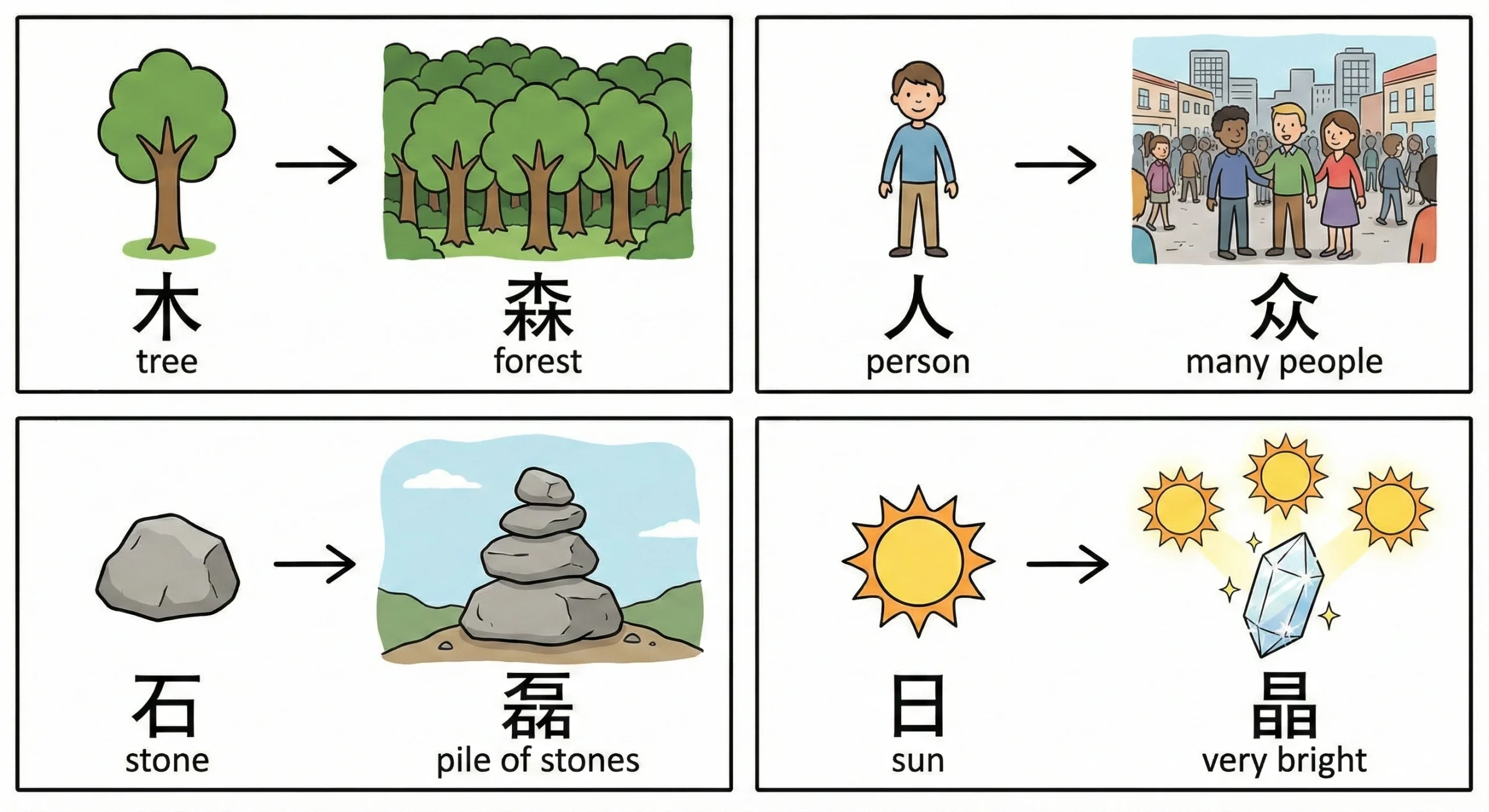
Students use visual associations and radicals to remember characters. For example:
-
“森” → three trees (木) together → a forest
-
“众” → three people (人) → many people
-
“磊” → three stones (石) → bright and upright
-
“晶” → three suns (日) → very bright
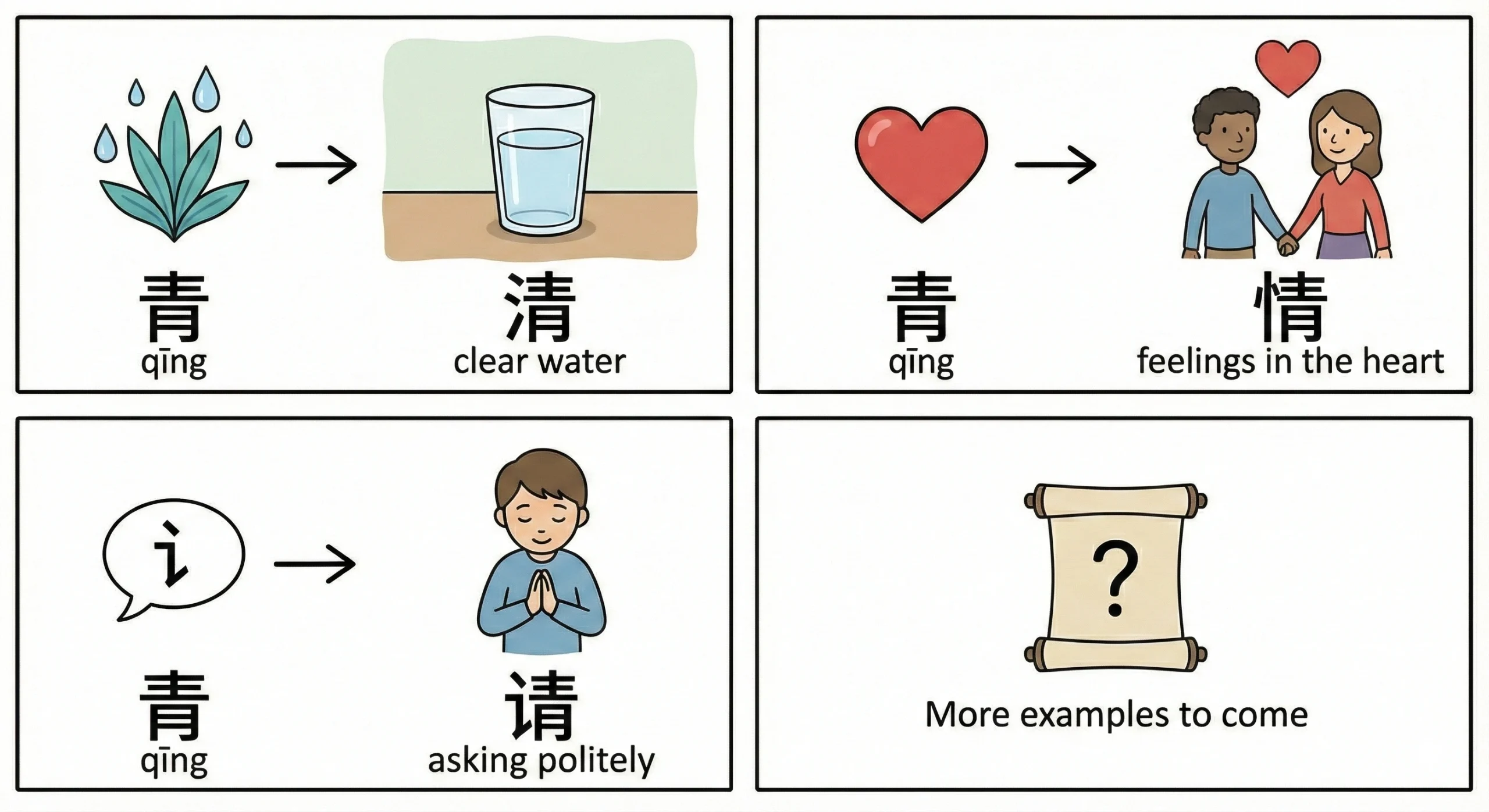
Break down radicals to understand meaning:
-
“清” = water (氵) + 青 → clear water
-
“情” = heart (忄) + 青 → feelings in the heart
-
“请” = speech (讠) + 青 → asking politely
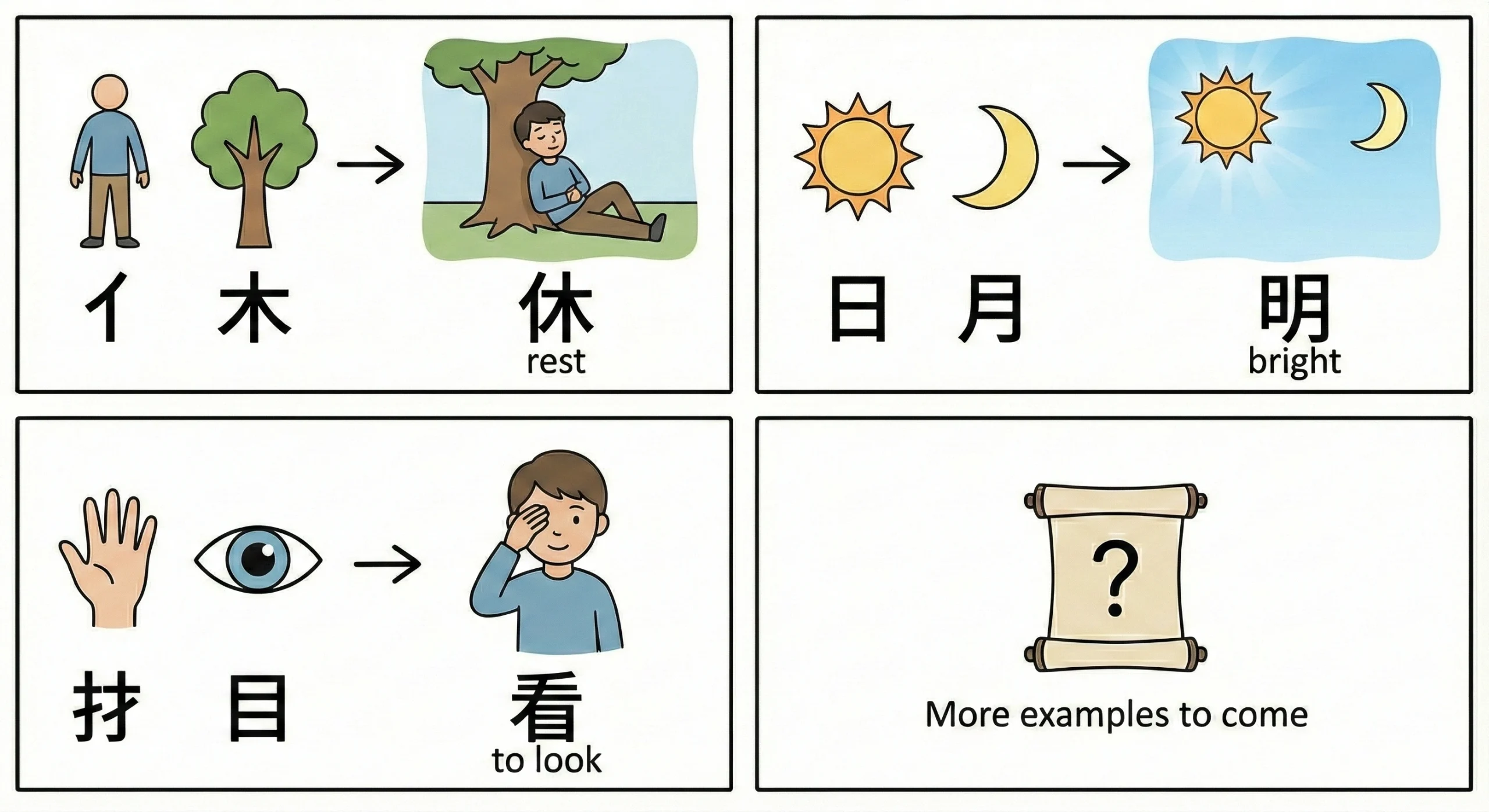
Memory tricks also help:
-
“休” in “休息” → a person (亻) leaning against a tree (木) to rest
-
“明” in “明天” → the sun (日) and the moon (月) together, so it means bright
-
“看” in “看见” → a hand (扌) placed above the eye (目) to look
Step 2: Remember(记住) – Deep understanding
Students learn the story behind each character to strengthen memory.
For example, “家” (home) has:
-
宀 (roof) on top
-
豕 (pig) below
-
In ancient times, a house with a pig was a home.
They also learn word combinations and sentence use:
-
Each character should have at least three common words
-
Write two sentences with each new word
-
For example, “清”: 清水 (clean water), 清楚 (clear), 清晨 (early morning)
Create personalised flashcards: write the character on the front, pinyin, radical, example words and sentences on the back, and add a small drawing to help memory. Review anytime, anywhere.
Step 3: Read(阅读) – Apply and consolidate
Encounter in real texts:
-
Read short passages containing new characters
-
Observe how the characters are used in different contexts
-
Understand their role in sentences
Practice by creating:
-
Write a diary using new characters
-
Compose short stories
-
Use them in conversations with parents
Regular review schedule:
-
Same day (1st review)
-
Three days later (2nd review)
-
One week later (3rd review)
-
One month later (4th review)
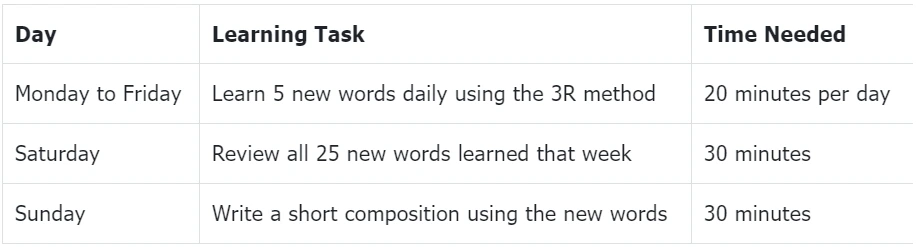
Weekly New Vocabulary Learning Plan
3R method in practice at Le Xue Education
We provide every student with:
-
Structured 3R learning materials and flashcards
-
Interactive,game-based learning activities
-
Fun small-group competitions
-
On-the-spot guidance and correction from teachers
Success story
Marcus learned over 1,000 new words in six months using the 3R method. His reading comprehension improved from D to A. He said, “Learning characters used to be painful, now it’s fun, like playing a game!”
Method 3: Build a Personal Composition Content Bank – Never Run Out of Ideas
The biggest challenge in PSLE compositions
According to the Ministry of Education (MOE), over 60% of students lose marks in PSLE compositions because their writing lacks content and details. Many students stare at the paper and have no idea what to write.
Why children struggle to write
Common reasons:
• Limited life experiences, no content to draw from
• Difficulty noticing details in daily life
• Rarely record ideas, forget them when needed
• Lack of a systematic way to organise writing material
Solution: Build a personal writing resource notebook
Organising method:
Prepare a notebook for writing materials and categorise them according to common PSLE themes.
-
People-related material
- Family: Dad’s hard work, Mom’s care, siblings’ funny stories
- Teachers: Memorable lessons, valuable guidance
- Friends: Friendship stories, time spent together
- Strangers: People who helped me, touching moments
-
-
Learning experiences: Overcoming difficulties, achievements through effort
-
Lessons from failure: Reflections and takeaways from mistakes
-
First experiences: First speech, first cooking attempt, first independent task
-
Personal changes: Progress made, conquering fearsGrowth-related material
-
-
Character-related material
-
Honesty: Value of honesty, consequences of lying
-
Courage: Facing challenges bravely
-
Filial piety: Caring for elders, helping family
-
Teamwork: Importance of cooperation
-
-
Society & environment material
-
Environment: Small eco-friendly actions, caring for the planet
-
Technology: Pros and cons of technology
-
Culture: Preserving traditional culture
-
“One Story a Week” Plan
Steps:
Sunday evening – Family sharing time (30 minutes)
-
The whole family sits together.
-
Each person shares their most memorable event of the week (parents participate too).
-
The child chooses one story to write in Chinese (200–300 words).
-
Parents help by:
-
Reminding about adding details (characters’ expressions, actions, dialogue)
-
Pointing out areas to improve
-
Polishing and editing together
-
Recording key points:
• Time, place, and people involved
• The course of events (cause, process, result)
• Personal feelings and thoughts
• Lessons learned
52-Week Story Collection:
• One year = 52 weeks → 52 real stories
• Each theme has at least 5–8 usable stories
• No worries about running out of content during PSLE essays
News Material Collection Method
Weekly News Study (Saturday morning, 30 minutes):
Choose suitable news:
• Avoid overly adult topics like politics or economy
• Focus on education, technology, environment, culture, and positive social news
• Sources: Lianhe Zaobao Student Edition, Channel NewsAsia Student News
Study Steps:
-
Read the news (parents can assist with understanding)
-
Discuss three questions in Chinese:
-
What is the event about?
-
What is your opinion?
-
What did you learn from it?
-
-
Briefly record in your material notebook (≈100 words)
-
Mark which essay themes it can be used for
Using News Material in Essays:
• Support your argument with evidence
• Use as an engaging introduction
• Make comparisons to highlight the theme
Example:
“According to news reports, Singapore produces a large amount of plastic waste every year. I think each of us should start with small actions to reduce the use of disposable plastic products…”
Daily Observation Training
Observation Exercises to Improve Attention:
Exercise 1: Character Observation
• Choose one person around you each week (family, teacher, classmate)
• Observe carefully for 3 days
• Record: appearance, speech style, habits, personality traits
• Write a short character description (≈150 words)
Exercise 2: Scene Description
• Choose a familiar place (classroom, park, home)
• Describe using your five senses: see, hear, smell, touch, taste
• Pay attention to time changes (morning vs evening, sunny vs rainy)
Exercise 3: Emotion Capture
• Record your emotions throughout the day
• Note feelings when happy, angry, sad, or nervous
• These emotion observations can be used in essays to make descriptions vivid
Real Case:
How Marcus Built His Personal Writing Resource Library
Back in P5, Marcus often struggled with PSLE Chinese essays. He would stare at the page thinking, “I don’t know what to write,” and his scores hovered around C-D. That all changed after joining LeXue Education.
After 3 months:
-
Marcus started a personal essay resource notebook and collected 12 family stories.
-
He learned to observe life details more closely.
-
His essay grades improved to a B.
After 6 months:
-
His resource library grew to over 30 stories.
-
He could quickly pick the right story for any essay topic.
-
His essay scores stabilized at an A.
PSLE Exam Performance:
-
When Marcus saw the essay topic “A Memorable Experience”, he immediately recalled three relevant stories from his resource library.
-
He chose the best one and added vivid details.
-
Result? A for his essay!*
Marcus shared:
“Now it’s not that I have nothing to write, but that I have to choose which story to use. My resource library gives me confidence to tackle any essay topic!”
How parents can help:
At LeXue Education, we support students by:
-
Providing a structured resource library template
-
Assigning weekly story collection tasks
-
Encouraging group sharing and peer learning
-
Guiding students on how to make stories more vivid and engaging
Want your child to start building their own writing resource library and ace PSLE Chinese? Book a free trial class today!

Method 4: Twice-Weekly Oral Practice – Don’t Ignore the 20% Oral Score
Why PSLE Chinese oral matters
Since the 2025 PSLE reform, the oral exam now counts for 20% of the total score, up from 15%. Many students do well in written papers but lose marks in oral, affecting their overall grade.
Key Focus of New Oral Exam
-
Greater focus on spoken expression and critical thinking
-
Not just reading and answering questions, but also analysing and discussing ideas
-
Tests students’ ability to respond on the spot
-
Students must clearly express their own opinions
At-Home Oral Practice Plan
Oral training should start early in the new school year, not only before the exam. Regular and systematic practice helps children build confidence and improve naturally.
Wednesday evening: Reading aloud practice (20 minutes)
Training Goals
-
Clear and accurate pronunciation
-
Smooth and fluent reading
-
Proper tone and emotion
-
Correct pausing and sentence breaks
Step-by-Step Practice Method
First Round: Slow Reading (5 minutes)
-
Choose a short passage (around 300 words)
-
Read slowly and carefully
-
Pay attention to:
-
Is each word pronounced correctly?
-
Which words are easy to misread?
-
Mark difficult words for practice
-
Second Round: Normal Speed + Recording (5 minutes)
-
Use a phone to record the reading
-
Read at a natural speed
-
Focus on tone and pauses
-
Imagine you are telling a story to someone
Third Round: Listen and Identify Problems (5 minutes)
-
Listen to the recording
-
Identify areas to improve, such as:
-
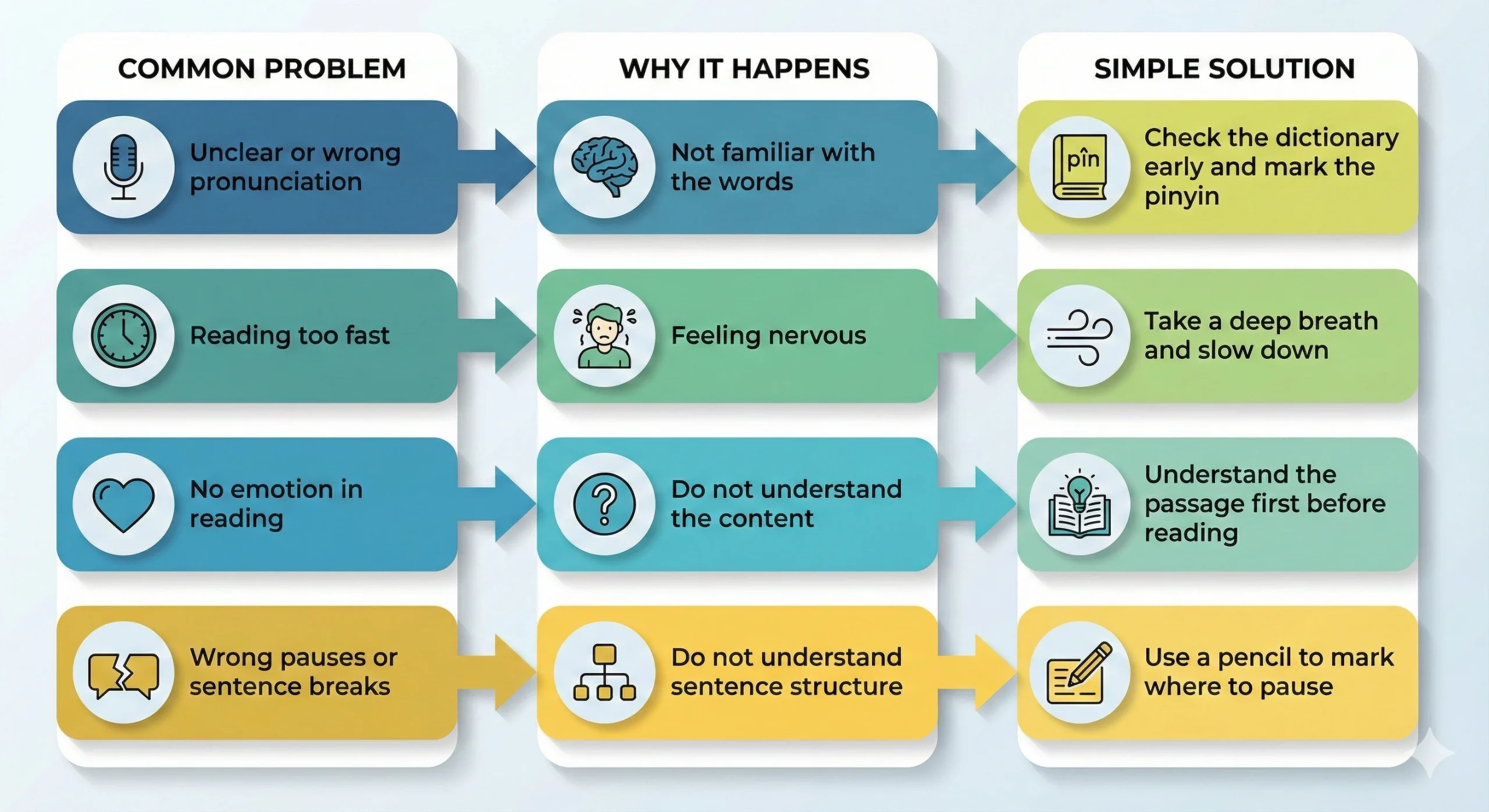
Wrong pronunciation
-
Reading too fast or too slow
-
Incorrect pauses
-
Lack of emotion
-
Fourth Round: Final Improved Reading (5 minutes)
-
Correct all the mistakes
-
Record again
-
Compare the second and fourth recordings
-
Let the child feel and recognise their improvement
Common Reading Mistakes and Solutions
Saturday Afternoon: Picture Description Practice (30 minutes)
Training Goals:
• Observation skills
• Description skills
• Logical thinking
• Quick response and confidence
Step 1: Prepare the Materials (5 minutes before)
• PSLE Chinese oral pictures (download past-year questions online)
• Or use daily life photos and news pictures
• Prepare 2–3 pictures with different themes each week
Step 2: Observe the Picture (2 minutes)
Give the child 2 quiet minutes to observe and think about:
• What can you see? (Who, What, Where, When)
• What are the people doing? What are their expressions?
• What might be happening?
• What message or idea does the picture show?
Step 3: Describe the Picture (2 minutes)
The child describes the picture in Chinese. Encourage:
• Clear structure (left to right, top to bottom, near to far)
• Specific details (colours, actions, facial expressions)
• Imagination (predict the situation and feelings)
Picture Description Framework
Opening: “This picture shows …”
Middle: “In the picture, there are … They are …
From …’s expression, I can tell …
I think they might …”
Ending: “This picture makes me think of …”
Step 4: Answer Questions (5 minutes)
Parents act as examiners and ask 3–5 questions.
Basic Questions:
• How many people are in the picture?
• Where are they?
• What are they doing?
Intermediate Questions:
• How do you think they are feeling? Why?
• If it were you, what would you do?
• Have you ever experienced a similar situation?
Advanced Questions:
• What lesson or message does this picture teach us?
• Do you agree with what the people in the picture did? Why?
Step 5: Feedback & Improvement (5 minutes)
• Parents point out what the child did well
• Give suggestions on areas to improve
• Encourage the child to try again
Quick Tips to Score Higher in Chinese Oral
- Use linking words for better flow:
• First, next, furthermore, finally• Because… so…• Although… but…• Not only… but also…• In conclusion, therefore…
-
Add personal opinions to show thinking:• I think…• In my opinion…• I feel that…• From my point of view…• Based on my experience…
-
Give examples to make answers concrete:• For example…• Such as…• Just like…• Take… as an example…
-
Use varied vocabulary, avoid repetition:Instead of always saying “very good” or “very beautiful”, try:• Excellent, outstanding, remarkable• Beautiful, pretty, elegant, magnificent
-
Express emotions to make descriptions vivid:• Happy: joyful, excited, thrilled, overjoyed• Sad: upset, unhappy, sorrowful, heartbroken• Angry: angry, annoyed, frustrated
Le Xue Oral Training Advantages
At Le Xue, we provide professional Chinese oral training designed to help every student excel in PSLE.
Expert Oral Training Courses:
• Dedicated oral practice sessions every week
• Small class sizes (6–8 students) so everyone gets a chance to speak
• Teachers give instant feedback on pronunciation and expression
• Recording playback for students to review and improve
Rich Practice Materials:
• PSLE past year picture question bank
• Themed picture materials covering different topics
• Simulated exam environment for real practice
Personalized Guidance:
• Targeted training to strengthen each student’s weak points
• Confidence-building for shy students
• One-on-one help for pronunciation problems
• Critical thinking exercises for students who need more practice
Proven Results:
• 70% of Le Xue students achieve A/A* in PSLE oral exams!
Student Success Story
Sophia was very shy and hesitant to speak Chinese. After six months of Le Xue oral training, she became confident and fluent. She scored full marks in her PSLE oral exam!
Sophia said:
“The teacher showed me that it’s okay to make mistakes. What matters is to speak up. Now, I’m not afraid of the oral exam anymore!”
Method 5: Make the Most of a “Mistakes Notebook” – Turn Weaknesses into Strengths
Why Chinese learning needs a mistakes notebook
Many parents think mistake notebooks are only for math or science. Actually, Chinese requires them even more! Here’s why:
• Knowledge points are scattered and easy to miss
• Mistakes tend to repeat
• Long-term accumulation and revision are needed
The magic of a mistake notebook
• Record characters that are often written or read incorrectly
• Organize common grammar mistakes
• Collect frequently misunderstood question types from comprehension and application exercises
• Identify the weak points
• Focus practice on areas that need improvement
How to Use a Chinese “Mistake Notebook” Effectively
Step 1: Organize by Categories
Get a thick notebook and divide it into these sections:
Part 1: Character Mistakes
What to record:
• Characters your child often writes incorrectly
• Characters your child often reads wrongly (add pinyin)
• Easily confused characters with similar shapes
Example format:
-
Date: Jan 5, 2026
-
Wrong character: “情楚”
-
Correct: 清楚 (qīng chǔ)
-
Memory tip: “清” has the water radical (氵), meaning clear
-
Word examples: 清水, 清晨, 清楚
-
Sentence: The teacher explained clearly, and I understood everything.
Confusing character comparison:
-
清 (氵) – clear water
-
情 (忄) – emotion/feeling
-
请 (讠) – request
-
晴 (日) – sunny
Part 2: Vocabulary Mistakes
What to record:
• Confusing words
• Incorrect usage
• Common collocation errors
Example format:
-
Confusing words: “必须” vs “必需”
-
必须 (bì xū) – must; emphasizes obligation (Example: Students must do their homework)
-
必需 (bì xū) – necessary; emphasizes need (Example: Water is a daily necessity)
Wrong vs Correct:
❌ 学生必需遵守校规 Students necessary follow school rules
✅ 学生必须遵守校规 Students must follow school rules
Part 3: Grammar Mistakes
Common errors:
• Wrong measure words
• Incorrect word order
• Punctuation mistakes
• Misuse of connecting words
Example format:
-
Error type: Measure word mistake
-
❌ 一根裤子
-
✅ 一条裤子 (correct)
-
✅ 一件衣服, 一双鞋子, 一顶帽子
Memory tip:
-
Clothes & hats → 件 / 顶
-
Pants → 条
-
Shoes & socks → 双
Part 4: Reading Comprehension Mistakes
What to record:
• Type of question
• Reason for the mistake
• Correct solving method
Example format:
-
Date: Jan 10, 2026
-
Question type: Vocabulary comprehension
-
Question: “他兴高采烈地回家了。” What does “兴高采烈” mean?
-
My wrong answer: very happy
-
Correct answer: in high spirits, full of energy, excited
-
Reason for mistake: didn’t understand fully; answer too simple
-
Lesson learned: Always give a complete explanation for idioms
Part 5: Composition Mistakes
What to record:
• Teacher’s corrections
• Common composition issues
• How to improve
Example format:
-
Date: Jan 15, 2026
-
Essay topic: “An Unforgettable Day”
Teacher’s feedback:
-
Introduction too plain: “Today was an unforgettable day”
-
Lacked detailed descriptions
-
Ending was abrupt
Improvement tips:
-
Start with environmental description or dialogue
-
Add actions, expressions, and speech
-
End by highlighting the theme and feelings
Good example:
-
Introduction: “Sunlight poured through the window, landing on my diary. Opening it, the day’s scenes appeared clearly before my eyes…”
Step 2: Regular Review Schedule
Weekly Review – Every Sunday (30 minutes):
-
Go through all mistakes recorded during the week
-
Redo the questions you got wrong
-
Check if you really understand and remember the answers
Monthly Review – Last Sunday of the Month (1 hour):
-
Organize all mistakes made during the month
-
Identify patterns and repeated errors
-
Make a targeted improvement plan
-
Track how your error rate has decreased
Pre-Exam Review – Two Weeks Before the Exam:
-
Focus on mistakes related to the exam topics
-
Pay special attention to repeated errors
-
Do extra practice on the same type of mistakes
-
Ensure you don’t make the same mistakes again
Review Tips:
-
Use different colored pens: first mistake (red), second time mistake (blue)
-
Check ✓ for fully mastered items
-
Star ⭐ for areas that still need improvement
-
Review frequently to reinforce memory
Step 3: Parent Involvement & Guidance
Weekly Spot Check (10 minutes):
-
Randomly check 5 questions from your child’s mistake notebook
-
Make sure your child truly understands the concept, not just memorizing answers
Questions Parents Can Ask:
-
“Why do you often get this word wrong?”
-
“How did you remember it this time?”
-
“Can you give another similar example?”
Praise & Motivation:
-
“You got this word wrong last week, but now you’ve mastered it! Well done!”
-
“Your mistake notebook is so neatly organized, keep it up!”
-
Give rewards when you see the error rate dropping
Success Story: Ethan’s Mistake Notebook Miracle
Ethan started using a mistake notebook in P5, and his mom shared their journey:
At the beginning (P5 Semester 1):
-
Lots of mistakes in every test
-
His mistake notebook was already full
-
Many errors kept repeating
After 3 months of consistency:
-
Started seeing improvements
-
Repeated mistakes clearly reduced
-
Test grades improved from C → B
After 6 months:
-
Fewer new mistakes added to the notebook
-
Old mistakes were fully mastered upon review
-
Test grades stabilized at A
During PSLE preparation:
-
Focused on revising the mistake notebook two weeks before the exam
-
During the exam, he immediately recalled similar mistakes
-
Carefully avoided common pitfalls
-
Final result: Chinese improved from C2 → AL1!
Ethan’s reflection:
“The mistake notebook helped me know my weak points and work on them. Seeing my error rate drop gave me a big sense of achievement. During PSLE, I had already seen many question types in my notebook, so I knew how to avoid mistakes.”
Ethan’s mom’s tip:
“At first, I supervised him daily to update the notebook. Later, he started doing it on his own. The key is letting kids see the notebook’s effect—they will keep at it. Even now, Ethan is in Secondary 1 and still uses his mistake notebook!”
Common Questions About Using a Mistake Notebook
Q1: My child thinks it’s troublesome and doesn’t want to do it. What should I do?
-
Don’t expect too much at first—just 1–2 mistakes a day isenough.
-
Sit with your child and do it together to build the habit.
-
Set small rewards: praise them if they keep it up for a week.
-
Once they see results, they’ll naturally keep going.
Q2: There are too many mistakes to record. What can we do?
-
Only record the important mistakes (not everything).
-
Focus on repeated mistakes or things they don’t fully understand.
-
You can take photos or cut-and-paste instead of writing everything by hand.
-
The key is to analyse why the mistake happened, not just copy the question.
Q3: Does it help if they record mistakes but don’t review them?
-
Not really! The core of a mistake notebook is review.
-
Set a fixed time to revise the notebook.
-
Parents can check regularly to make sure they review properly.
-
Reviewing is more important than just recording.
How Le Xue Supports Students
-
Provide ready-made mistake notebook templates and guidance.
-
Check students’ mistake notebooks weekly.
-
Create personalised learning plans based on their mistakes.
-
Run mistake notebook competitions to encourage engagement and improvement.
Method 6: Join Professional Tuition Classes – Learn Smarter, Not Harder
Why start tuition at the beginning of the school year?
According to MOE data, around 72% of Primary 6 students attend Chinese tuition. Many parents choose tuition because it helps students’ study systematically and effectively.
Benefits of Chinese Tuition:
-
Structured Learning: Complete syllabus coverage, no knowledge gaps.
-
Professional Guidance: Experienced teachers who know exam trends.
-
Time-Saving: Learn efficiently and avoid wasted effort.
-
Targeted Focus: Identify weak areas and improve them quickly.
-
Peer Motivation: Small group learning encourages students to support each other.
When is the best time to start tuition?
Ideal time: Start at the beginning of P5 or P6.
Why:
-
Enough time to learn systematically (18–24 months).
-
Build from the basics, leaving no gaps.
-
Progress gradually with less pressure.
-
Time to consolidate and improve skills before PSLE.
Not recommended: Starting tuition only 6 months before PSLE. Problems:
-
Too little time to cover everything properly.
-
Last-minute cramming often leads to limited results.
-
High stress can affect confidence.
-
Students may focus on some areas while neglecting others.
How to Choose the Right Chinese Tuition Class
With so many tuition centres around, how do parents pick the right one? Here are the key factors to consider:
-
Teacher Experience (Most Important!)Check if the teacher:
-
Has MOE school teaching experience
-
Understands the latest PSLE exam trends
-
Has many years of Chinese teaching experience
-
Can provide successful student case studies
Watch out for:-
University students without teaching experience
-
Centres that change teachers frequently
-
Teachers who just follow the textbook without their own method
Le Xue Education’s Teacher Advantage ✅-
Vivien Le: 24 years of Chinese teaching experience
-
Former Catholic High senior Chinese teacher
-
Singapore Chinese education expert
-
Creator of the 3R Learning Method, helping 2000+ students succeed
-
-
Teaching Method (The Key to Results!)When choosing a Chinese tuition class, ask:
-
Is it rote learning or understanding-based learning?
-
Does the teacher have a unique teaching method?
-
How do they motivate students to enjoy learning?
-
How do they ensure students truly master the content?
Characteristics of a good teaching method:-
Fun and engaging – learning is enjoyable, not boring
-
Focus on understanding – not just memorising
-
Systematic and structured – complete learning framework
-
Results-driven – progress is visible
Le Xue Education’s exclusive 3R Learning Method:-
Recognise (认识): Use visual associations for quick memory
-
Remember (记住): Deep understanding for long-term retention
-
Read (阅读): Apply knowledge flexibly in real situations
-
Learning speed improves by 5×!
-
- Class Size (Ensuring Individual Attention!)
Small classes (6–8 students) advantages:✅ Teacher can focus on every student✅ Each child gets a chance to speak✅ Targeted, personalised guidance✅ More interactive and engaging lessons✅ Better learning outcomesLarge classes (15–20 students) issues:❌ Teacher cannot give enough attention❌ Shy students may be ignored❌ Hard to provide personalised guidance❌ Teaching is often at average pace for the class❌ Learning outcomes are compromisedOne-to-one tuition:
-
Suitable for students who are very weak or very strong
-
Cons: Limited peer interaction, higher cost
-
Recommendation: Small group classes are more cost-effective
Le Xue Education’s 6–8 student premium small classes:-
Ensure every child receives individual attention
-
Encourage group discussion and peer learning
-
Teacher remembers each student’s strengths and weaknesses
- Provides targeted guidance for significant results
-
-
Learning Outcomes (Proven Results!)When choosing a Chinese tuition centre, check:
-
How have students performed in past PSLE exams?
-
How many students improved to AL1/AL2?
-
Are there real parent or student testimonials?
-
How significant is the improvement (from which grade to which grade)?
Be cautious of centres that:-
Only claim “many students do well” without concrete data
-
Cannot provide real success cases
-
Avoid talking about results and focus only on teaching philosophy
Le Xue Education’s proven results: 📊-
70% of students achieve AL1/AL2
-
Over 2,000 student success stories
- Average improvement of 2–3 grades
Real student cases:-
Catherine: Failed → PSLE AL1
-
Marcus: Composition C → Composition A*
-
Ethan: C2 → AL1
-
Sophia: Shy in oral → Full marks in PSLE oral
-
-
Location & Schedule (Convenience Matters!)Location:
-
Close to home, saving commuting time
-
Easy transport access for parents
-
Safe environment with good facilities
Schedule:-
Fits your child’s daily routine
-
Doesn’t interfere with school homework
-
Enough time for rest
📍Le Xue Education has 4 convenient branches:-
Bishan
-
Kovan
-
Queens Road
-
Parkway Centre
Flexible class timing options:-
Weekend mornings or afternoons
-
Weekday after-school sessions
-
Adjustable to fit parent schedules
-
- Trial Classes (Experience It Yourself!)
Why try a trial class? A trial lets you see:
-
The teacher’s teaching style
-
Whether your child enjoys the class
-
The overall classroom vibe
-
If the teaching methods suit your child
What to observe during trial:-
Is the teacher patient and approachable?
-
How do other students respond?
-
Is the class schedule well-organized?
-
How does your child feel after the class?
Le Xue Education trial class benefits:-
Full 1.5-hour class experience
-
Real classroom, not just a demo
-
No pressure after trial – let your child decide
-
Free learning diagnostic report after the class
-
-
Fees & ValueFee considerations:
-
Expensive doesn’t always mean better
-
Cheapest isn’t always the best
-
Focus on value for money
Value Formula:Value = (Teacher + Teaching Method + Class Size + Results) ÷ Fee -
Why Choose Le Xue Education?
✨ Trusted 24 Years of Teaching Experience Vivien Le – Founder & Lead Teacher
-
Former senior Chinese teacher at Catholic High School
-
24 years of experience in teaching Chinese
-
Deep understanding of Singapore’s Chinese education system
-
Familiar with PSLE exam trends and updates
📚 Exclusive 3R Learning Method – Study Smarter, Faster 3R Method (Recognise → Remember → Read):
-
Scientific step-by-step learning process
-
Boosts learning speed by up to 5×
-
Focuses on understanding, not rote memorization
-
Has helped over 2,000 students achieve success
🏆 Proven Results – Real Achievements
-
70% of students achieve PSLE AL1/AL2
-
Average improvement of 2–3 grades
-
Students don’t just score better—they love learning Chinese
-
Builds long-term learning skills
👥 Small Classes – Personalized Attention 6–8 students per class:
-
Every child gets noticed and guided
-
Targeted support for individual needs
-
Group discussions encourage peer learning
-
Teachers remember each student’s strengths and weaknesses
📍 Convenient Locations
-
Bishan | Kovan | Queens Road | Parkway Centre
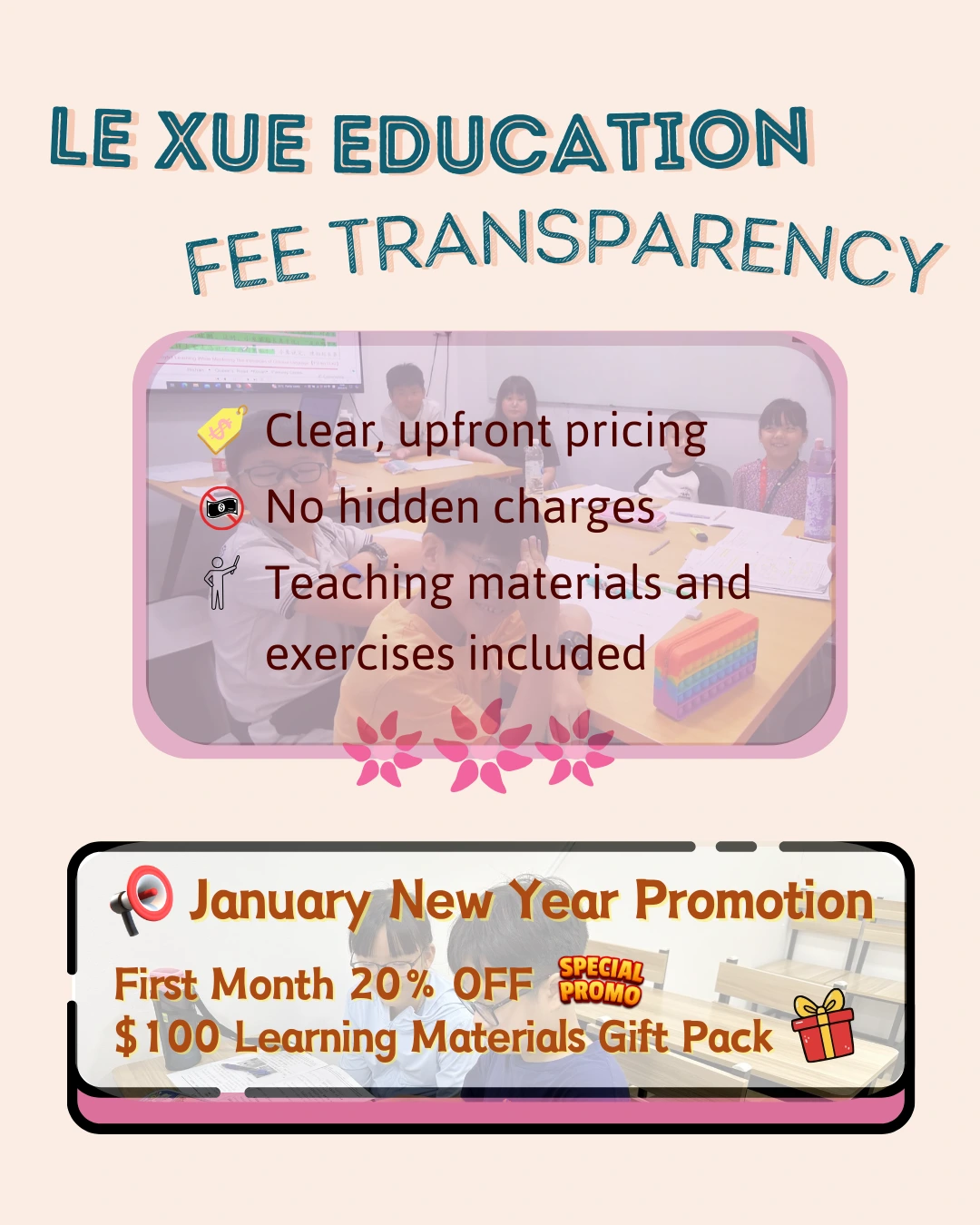
🎁 Special New Year Promotion
-
20% off first month tuition
-
Free $100 learning materials pack
-
Limited to first 50 sign-ups
-
Start the year right—secure your child’s spot today!
New Year, New Start, New Hope
The preparation for PSLE Chinese 2026 starts today! By building good learning habits, practicing consistently every day, and combining it with professional guidance, your child can achieve excellent results in Chinese.
6 Golden Methods to Boost Your Child’s Chinese:
1️⃣ 15-Minute Daily Morning Reading – Develop language intuition
2️⃣ 3R Learning Method for Characters – Learn faster and remember better
3️⃣ Build a Personal Writing Material Library – Say goodbye to “nothing to write”
4️⃣ Twice-Weekly Oral Practice – Capture the extra 20% marks
5️⃣ Use a “Mistakes Notebook” – Turn weaknesses into strengths
6️⃣ Join a Professional Tuition Class – Learn systematically and efficiently
Remember, mastering Chinese is a gradual process, not an overnight success. Start cultivating these habits from the very first day of the new school year.
-
3 months later: You will see noticeable progress
-
6 months later: Your child will enjoy learning Chinese
-
1 year later: On PSLE exam day, your child will be confident and ready!
Le Xue Education New Year Promo – Limited Slots!
🎊 Get 20% off your first month’s tuition
🎁 Free $100 learning materials gift pack
👥 Limited to the first 50 students
⏰ Promo ends: 31 January
📞 Book a free trial class now:
☎️ 6554 1683 📱 WhatsApp: 8323 7619
📍 4 convenient locations:
Bishan | Kovan | Queens Road | Parkway Centre
Let Le Xue Education guide your child to confidently tackle PSLE Chinese 2026! New year, new start – take action now! 💪
About the Author
Vivien Le
• Founder and Lead Teacher of Le Xue Education
• 24 years of experience teaching Chinese
• Former senior Chinese teacher at Catholic High School
• Creator of the 3R Learning Method
• Has helped over 2,000 students achieve excellent results in Chinese exams